Motional has begun high-speed, closed-course testing of its all-electric Hyundai IONIQ 5 robotaxis, hitting autonomous highway speeds of 75 mph at Hyundai’s proving grounds in California City, California. The company says the work is an important milestone as it prepares its driverless service to move beyond dense urban cores and onto freeways.
The tests were conducted on a 6.4-mile oval track at Hyundai’s facility, leveraging Motional’s strategic partnership with Hyundai Motor Group and engineering support from Hyundai America Technical Center, Inc. (HATCI).
From city streets to highway ODD
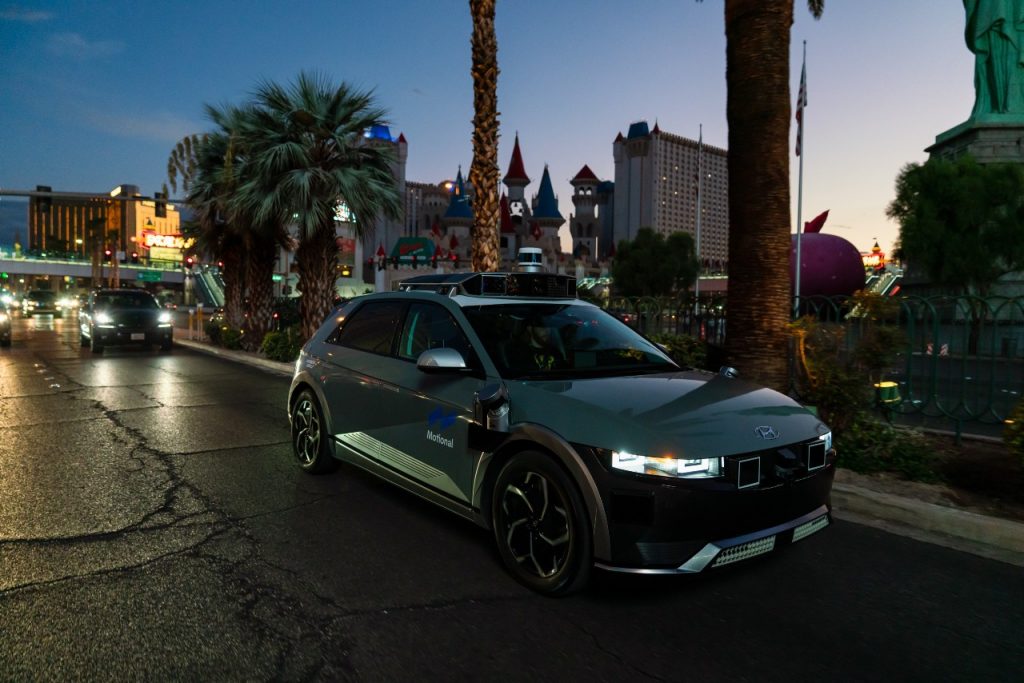
Motional’s IONIQ 5 robotaxis are already a familiar presence in complex urban environments including Pittsburgh, Las Vegas and Los Angeles, where the company has focused development on busy city streets rather than lower-stress suburban routes.
The new proving-grounds program extends that operational design domain to freeway speeds. According to Motional, the vehicles ran autonomously at up to 75 mph while engineers gradually increased both speed and maneuver complexity, collecting performance data on lateral and longitudinal control. That data is being used to tune braking, acceleration and steering behavior at high speed.
Motional frames highway competence as a prerequisite for “broad robotaxi deployments,” arguing that a commercially relevant driverless service will need to operate across mixed networks of surface streets and freeways, not just downtown cores.
Simulation first, proving grounds second
Before greenlighting the high-speed track tests, Motional’s engineering team ran the new capabilities through an internal simulation pipeline. The company describes a “data-driven process” that uses custom simulation tools to validate behavior, safety margins and controller performance virtually before exposing vehicles to higher-risk real-world scenarios.
During the proving-grounds campaign, the team then focused on correlating simulation results with vehicle measurements, using the track environment to check controller robustness and passenger comfort as speeds increased. The company notes that non-engineering staff have also been enlisted to ride in the vehicles and provide subjective comfort feedback, which is then matched against logged vehicle dynamics to refine control strategies.
Motional says it is also applying machine learning to predict how riders will react to specific events—part of a broader effort to optimize not just safety, but ride quality and acceptance.
Positioning for commercial service and beyond
The highway work comes as Motional moves toward scaled production and commercial deployment of the IONIQ 5 robotaxi. Hyundai Motor Group has previously announced that the first production robotaxis will be built at its Hyundai Motor Group Innovation Center in Singapore (HMGICS) and deployed into U.S. services, and that the IONIQ 5 robotaxi is among the first SAE Level 4 vehicles certified under U.S. Federal Motor Vehicle Safety Standards.
The company already operates IONIQ 5 robotaxis in Las Vegas in partnership with ride-hail platforms, and has been expanding service hours and capabilities—including night operations and remote vehicle assistance—to remove the need for onboard safety operators.
In its announcement, Motional also points to use cases “beyond Level 4 operations,” suggesting that the high-speed control stack and validation methods developed for the robotaxi could be adapted to other advanced driver assistance or supervised automation programs within Hyundai Motor Group’s portfolio.
Competitive pressure on highway capability
For the broader autonomous vehicle sector, Motional’s decision to spotlight track testing at 75 mph underscores an emerging competitive emphasis on highway operation. Robotaxi programs from other players have tended to focus their initial commercial services on lower-speed urban environments, even when their technology stacks also support freeway driving.
Highway operation brings its own challenges—shorter time-to-collision at higher speeds, more stringent comfort expectations for lane-keeping and lane changes, and complex merges and splits at interchanges—but it is also core to making robotaxis a credible alternative to private vehicles for longer cross-town trips.
Motional’s message with this latest milestone is that it is working toward that combined city-plus-highway operating model, with a testing program that moves from simulation, to closed-course proving grounds, and eventually to public freeways as the company prepares a fully driverless commercial launch.